


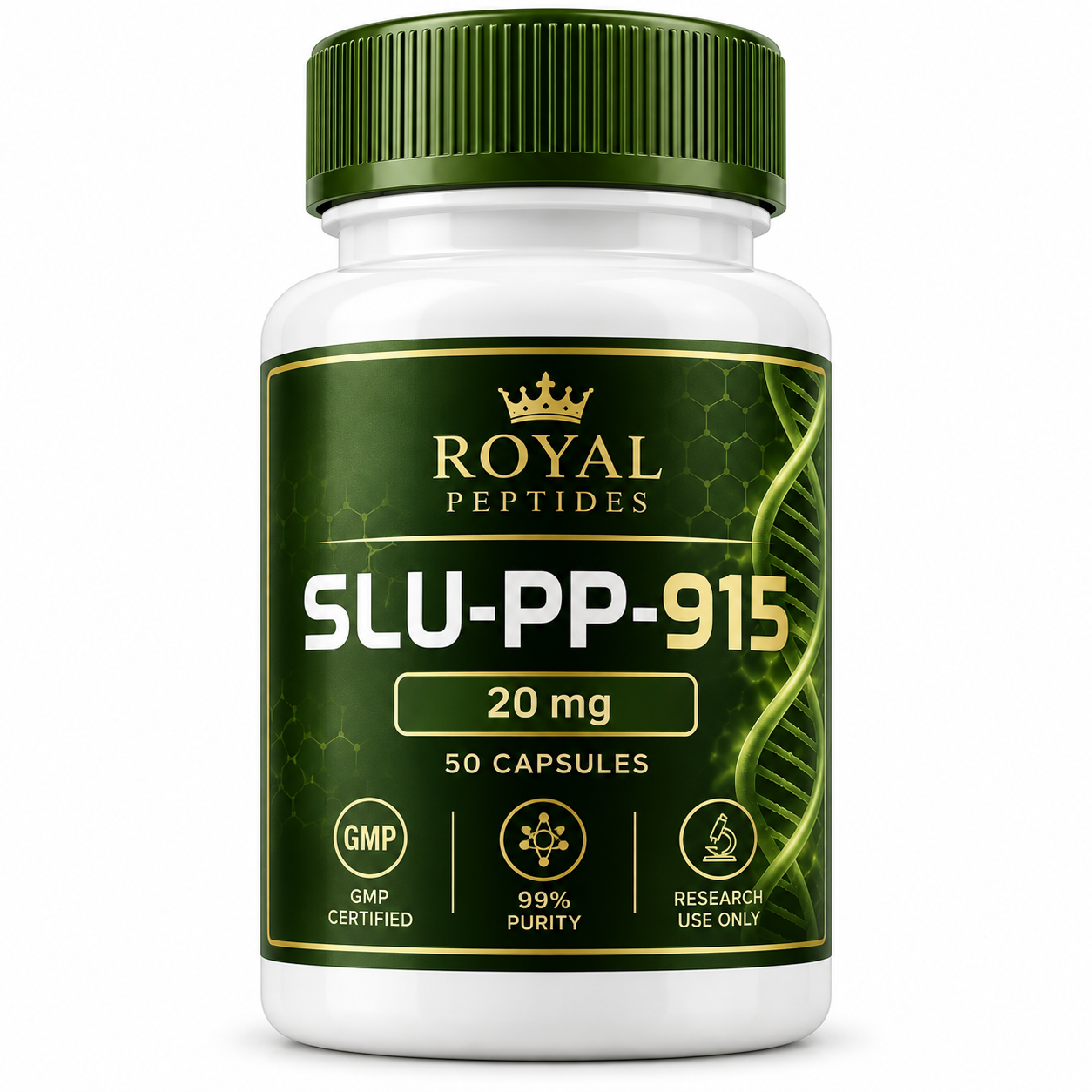
 SLU-PP-915 Research Compound
 Price range: $185 through $365Select options
Royal Peptides products are offered exclusively for laboratory research, analytical, and scientific applications. Not for human or veterinary use.
Royal Peptides supplies compounds intended for controlled laboratory research and analytical applications.
Where applicable, Royal Peptides research materials are supplied in lyophilized form.
Lyophilization is a freeze-drying process used to remove moisture from material under controlled conditions.
Storage requirements may vary by compound, formulation, and production lot. Refer to the product label and available product-specific documentation.
Packaging components may vary slightly between production lots. This can include vial closures, cap styles, label positioning, and external packaging.
SLU-PP-915 is a chemically distinct synthetic small-molecule pan-estrogen-related receptor agonist investigated across ERRα, ERRβ and ERRγ. Published preclinical research has examined its oral bioavailability, mitochondrial and metabolic signaling, ERR-regulated gene expression and exercise-associated biology.
SLU-PP-915 is an experimental synthetic small molecule identified during medicinal-chemistry research into potent agonists of the estrogen-related receptor family.
The compound belongs to a chemical series of 2,5-disubstituted thiophenes investigated for estrogen-related receptor activity. SLU-PP-915 contains a boronic-acid moiety and was characterized as a potent pan-ERR agonist with activity across ERRα, ERRβ and ERRγ.
SLU-PP-915 is not a peptide. It is a chemically distinct small-molecule research compound developed after earlier work involving experimental ERR agonists such as SLU-PP-332.
Estrogen-related receptors are nuclear receptors involved in the transcriptional regulation of genes associated with cellular energy metabolism. SLU-PP-915 is used experimentally to investigate the effects of pharmacological activation of this receptor family.
Published medicinal-chemistry research reported significant upregulation of established ERR target genes following experimental exposure to SLU-PP-915, including genes relevant to metabolic and exercise-associated signaling.
SLU-PP-915 has been investigated across several interconnected areas of nuclear-receptor, metabolic and mitochondrial research.
Experimental investigation of agonist activity across estrogen-related receptors ERRα, ERRβ and ERRγ.
Research involving ERR-regulated pathways associated with mitochondrial biogenesis, oxidative phosphorylation and cellular energetics.
Preclinical investigation of ERR activation, muscle gene expression and biological responses associated with aerobic exercise.
Later preclinical work demonstrated biological activity following oral administration of SLU-PP-915 in mouse models.
One of the most important research characteristics distinguishing SLU-PP-915 from the earlier SLU-PP-332 compound is its oral bioavailability in preclinical mouse research.
Published 2026 research characterized SLU-PP-915 as a chemically distinct ERR pan-agonist that maintained biological efficacy following oral administration in mice when systemic exposure was taken into account.
Preclinical distinction: oral bioavailability or biological activity in mice does not establish human oral pharmacokinetics, efficacy, dosing or safety.
The medicinal-chemistry program that produced SLU-PP-915 explored a new series of 2,5-disubstituted thiophenes designed as potent estrogen-related receptor agonists.
Researchers found that phenolic or aniline groups within the chemical series could be replaced with a boronic-acid moiety while maintaining ERR activity. Compounds containing this structural feature demonstrated improved metabolic stability in experimental microsomal assays compared with corresponding aniline or phenol compounds.
SLU-PP-915 emerged as one of the potent compounds from this series and was subsequently investigated in gene-expression and in-vivo experiments.
Published medicinal-chemistry research investigated whether SLU-PP-915 could influence established transcriptional targets of estrogen-related receptor signaling.
In experimental models, SLU-PP-915 significantly upregulated several ERR-associated genes, including PGC-1α, LDHA, DDIT4 and PDK4.
These findings are relevant to the study of ERR-controlled transcriptional networks associated with mitochondrial biology, energy metabolism and exercise-associated cellular responses.
Classification: SLU-PP-915 is most precisely described as a pan-ERR agonist. Changes in PGC-1α expression observed experimentally should not be confused with describing PGC-1α as the compound's direct receptor target.
ERRα, ERRβ and ERRγ participate in transcriptional programs associated with mitochondrial function and cellular energy metabolism. These pathways also contribute to skeletal-muscle adaptation to aerobic exercise.
In mouse research, SLU-PP-915 was investigated for its ability to influence exercise-associated gene expression and aerobic exercise capacity. The published work reported increased running distance and duration in the experimental model.
Researchers also examined expression of DNA damage-inducible transcript 4 (Ddit4), an exercise-responsive gene, and reported that SLU-PP-915 could further influence exercise-associated transcriptional responses when studied alongside exercise training.
Research terminology: “exercise mimetic” describes an experimental research concept. Animal exercise-capacity findings do not establish comparable effects or clinical outcomes in humans.
Estrogen-related receptors regulate transcriptional programs involved in mitochondrial biogenesis, oxidative phosphorylation, fatty-acid oxidation and cellular energy metabolism.
This connection between ERR signaling and cellular energetics is a major reason SLU-PP-915 is being investigated as an experimental chemical tool in metabolic, mitochondrial and exercise-associated research.
The published literature remains preclinical. Findings from cell-based and animal models do not establish human therapeutic efficacy or safety.
Research published in 2026 further characterized SLU-PP-915 using liquid chromatography–high-resolution tandem mass spectrometry and in-vitro metabolic systems involving human liver S9 fractions and human liver microsomes.
Researchers identified seven Phase-I transformation products for SLU-PP-915 in the experimental systems studied. Three selected metabolites were additionally confirmed through chemical synthesis and nuclear magnetic resonance analysis.
These findings contribute to analytical characterization and metabolite identification. In-vitro liver-derived systems do not establish human clinical pharmacokinetics or safety.
Explore the differences in chemistry, ERR pharmacology, oral bioavailability, metabolism and published preclinical evidence.
SLU-PP-915 is an experimental synthetic small molecule characterized in published research as a pan-estrogen-related receptor agonist.
No. SLU-PP-915 is a synthetic small molecule rather than a peptide.
Published research characterizes SLU-PP-915 as a pan-ERR agonist with activity across ERRα, ERRβ and ERRγ.
Published preclinical research reports oral bioavailability and biological activity for SLU-PP-915 in mice. This does not establish human oral pharmacokinetics or clinical use.
They are chemically distinct pan-ERR agonists. One important published distinction is that SLU-PP-915 demonstrated oral bioavailability in mouse research, whereas lack of oral bioavailability was identified as a limitation of SLU-PP-332.
Preclinical studies have investigated whether pharmacological ERR activation can reproduce selected molecular responses associated with aerobic exercise. The term describes a research concept and does not establish that the compound substitutes for physical exercise in humans.
The published evidence discussed here is preclinical. Animal and laboratory findings do not establish human clinical efficacy, dosing or safety.
Product information pulled directly from WooCommerce.
Review available analytical documentation for the applicable product and batch.
View Analytical Documentation →Match available documentation to the applicable research material and batch.
Review the analytical information provided for the selected batch where available.
Keep relevant product and batch documentation with your research records.
Shipping options and delivery estimates are shown at checkout. Refer to the product label and applicable documentation for handling and storage information.
Complete payment using the available methods presented during checkout.
Tracking information is provided when available for the selected delivery service.
Use the product label and applicable documentation for handling and storage guidance.
SLU-PP-915 Research CompoundSLU-PP-915 Research Compound
Confirm your eligibility to enter the Royal Peptides research portal.
The products and information presented on this website are intended strictly for laboratory, analytical and scientific research purposes only. They are not intended to diagnose, treat, cure, or prevent any disease and are not intended for human or veterinary use, ingestion, consumption, or therapeutic application.
MISUSE OF THESE PRODUCTS IS STRICTLY PROHIBITED.