Eloralintide vs Cagrilintide, Retatrutide & Tirzepatide
A research-focused comparison of four prominent metabolic compounds across receptor targets, molecular strategy, published clinical evidence and development status. The compounds overlap in research context, but they do not operate through the same receptor pathways.
Four compounds. Different research strategies.
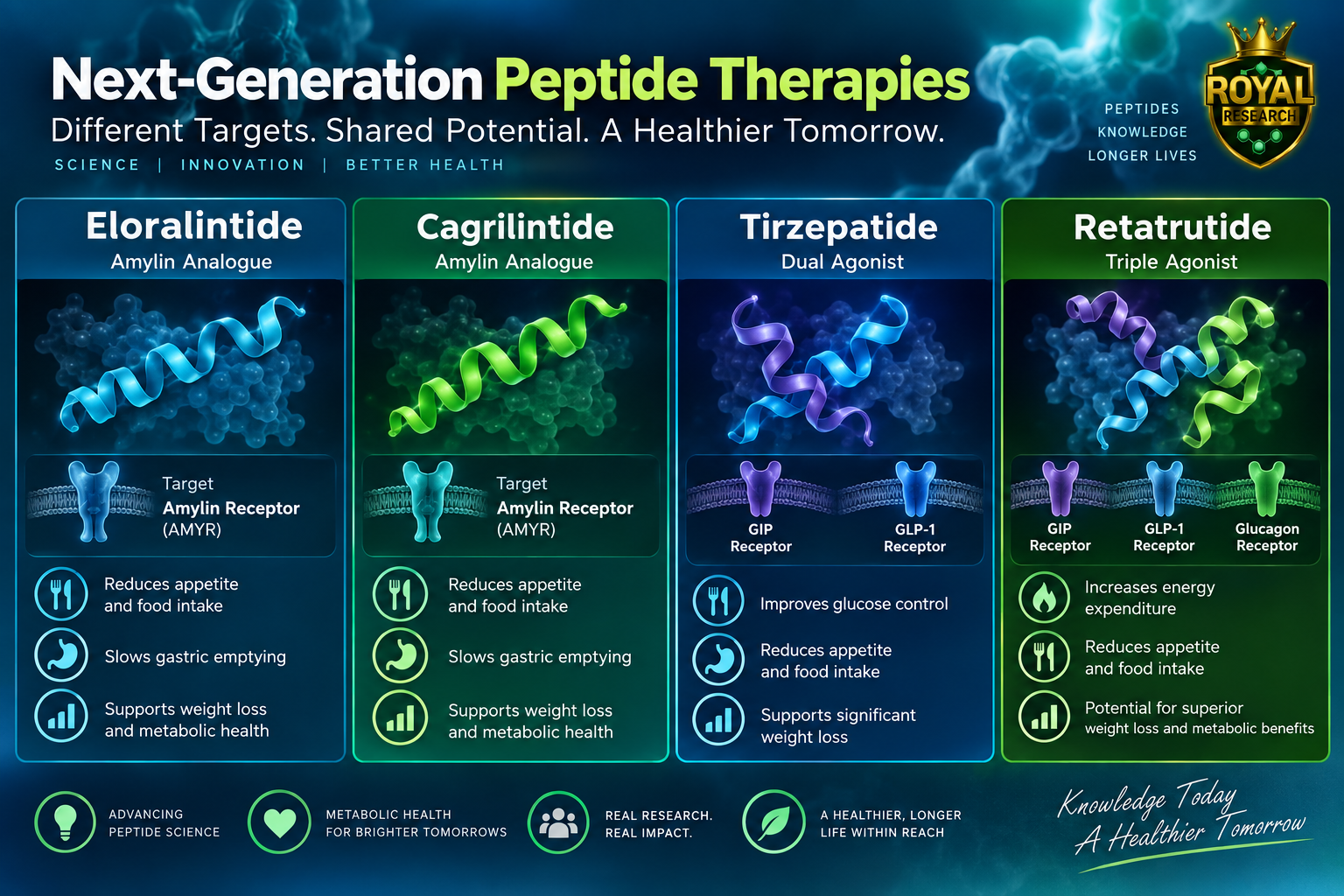
Eloralintide and Cagrilintide are centered on the amylin pathway. Tirzepatide is a dual GIP and GLP-1 receptor agonist. Retatrutide extends the incretin strategy by combining GIP, GLP-1 and glucagon receptor agonism.
Eloralintide
Selective amylin receptor agonist
Cagrilintide
Long-acting amylin analogue
Retatrutide
Multi-receptor investigational agonist
Tirzepatide
Dual GIP / GLP-1 receptor agonist
What is Eloralintide?
Eloralintide (LY3841136) is an investigational peptide being studied as a selective amylin receptor agonist. Its research strategy differs fundamentally from GLP-1-centered compounds because its primary pharmacological pathway is amylin receptor signaling.
Amylin-focused
Published clinical research describes Eloralintide as a selective amylin receptor agonist rather than a GLP-1 receptor agonist.
Distinct pathway
That distinction makes Eloralintide particularly relevant when researchers compare amylin-based strategies with incretin and multi-receptor approaches.
Clinical development
A published 48-week Phase 2 randomized trial evaluated multiple Eloralintide regimens in adults with obesity or overweight and a weight-related comorbidity without type 2 diabetes.
Published Eloralintide Phase 2 research
The 2025 Lancet publication provides the most useful peer-reviewed clinical reference for interpreting Eloralintide as of this update.
Eloralintide vs Cagrilintide
This is the most direct pathway comparison on the page because both compounds are associated with amylin biology. They should not, however, be treated as interchangeable molecules.
Eloralintide
Investigational selective amylin receptor agonist developed by Eli Lilly.
- Research identifier LY3841136
- Selective amylin receptor agonist strategy
- 48-week Phase 2 data published in The Lancet
- Investigational
Cagrilintide
Investigational long-acting amylin analogue developed by Novo Nordisk.
- Long-acting amylin analogue
- Phase 2 dose-finding research published in The Lancet
- Also studied in combination-development programs
- Investigational
Eloralintide vs Retatrutide
Eloralintide and Retatrutide are especially useful to compare because they represent substantially different receptor strategies: an amylin-focused compound versus a triple GIP, GLP-1 and glucagon receptor agonist.
Eloralintide
- Primary research pathway: amylin
- Selective amylin receptor agonist
- LY3841136
- Investigational
Retatrutide
- GIP receptor agonism
- GLP-1 receptor agonism
- Glucagon receptor agonism
- LY3437943 — investigational
Eloralintide vs Tirzepatide
Eloralintide and Tirzepatide are pharmacologically distinct. Tirzepatide acts through GIP and GLP-1 receptors, whereas Eloralintide is being investigated through an amylin receptor strategy.
Eloralintide
Selective amylin receptor agonist under clinical investigation. It is not simply another GLP-1 compound.
Tirzepatide
Dual GIP and GLP-1 receptor agonist. Tirzepatide is an approved active ingredient in medicines for specified FDA-approved indications.
Amylin vs GLP-1, GIP & glucagon
Looking at receptor architecture makes the differences between these four compounds easier to understand than treating them as members of one interchangeable category.
| Compound | Amylin pathway | GLP-1 receptor | GIP receptor | Glucagon receptor |
|---|---|---|---|---|
| Eloralintide | Primary pathway | — | — | — |
| Cagrilintide | Primary pathway | — | — | — |
| Tirzepatide | — | ✓ | ✓ | — |
| Retatrutide | — | ✓ | ✓ | ✓ |
What has actually been reported?
Trial percentages can be informative, but they become misleading when numbers from separate studies are treated as though the compounds were tested against one another. They were not.
Eloralintide Phase 2
In the published 48-week trial, mean body-weight change under the efficacy estimand was approximately −9% at 1 mg, −12% at 3 mg, −18% at 6 mg, −20% at 9 mg, −20% in the 6→9 mg group and −16% in the 3→9 mg group, compared with −0.4% for placebo.
Source: Billings et al., The Lancet, 2025.
Cagrilintide Phase 2
The published dose-finding Phase 2 study evaluated once-weekly Cagrilintide over a 26-week treatment period. The study included multiple Cagrilintide dose groups as well as active-control and placebo groups.
Source: Lau et al., The Lancet, 2021.
2026 Retatrutide Phase 3 update
Lilly reported TRIUMPH-1 Phase 3 results in 2026. Under the efficacy estimate at 80 weeks, the company reported the following average changes from baseline. These are sponsor-reported Phase 3 results and are not a head-to-head comparison with Eloralintide.
Why cross-trial percentages need context
Population
Eligibility criteria, baseline characteristics, diabetes status and comorbidities can differ materially between studies.
Duration
A 26-week, 48-week and 80-week endpoint cannot be treated as the same observation period.
Estimand
Trial product, treatment-policy, efficacy and treatment-regimen estimands can answer different statistical questions.
Dose strategy
Fixed doses, escalation schedules and maximum tolerated strategies differ between development programs.
Missing data
Discontinuations and statistical handling of missing observations influence reported estimates.
No head-to-head trial
Separate placebo-controlled trials do not establish which of these compounds would outperform another in the same population.
What the available data do not establish
No direct superiority ranking
Separate clinical programs do not provide a scientifically sound basis for declaring Eloralintide, Cagrilintide, Retatrutide or Tirzepatide universally superior to the others.
Mechanism is not outcome
Receptor pharmacology helps explain how compounds differ, but receptor count or pathway novelty does not by itself establish clinical effectiveness or safety.
Evaluating Eloralintide research materials
For laboratory procurement, the useful question is not simply whether a supplier lists Eloralintide. Researchers should evaluate what documentation is available for the specific material being offered.
Batch documentation
Look for documentation that can be associated with the relevant product or batch rather than relying only on generic marketing statements.
Analytical methods
Review what each analytical report actually measures. Purity, identity and other analytical questions require appropriate methods and should not be treated as interchangeable.
Traceability
Product labeling, lot references and documentation should make it possible for a laboratory to understand what material a report corresponds to.
Research availability & documentation
Royal Peptides lists laboratory research materials separately from this educational comparison. Review product information and available analytical documentation before procurement.
Review the COA Vault
Analytical documentation should be evaluated on its own terms, including the stated method, reported result and relationship to the relevant research material.
Royal Peptides materials are offered for laboratory research purposes only. Not for human consumption. This page is educational research content and does not provide medical advice, diagnosis, treatment, dosing or administration guidance.
Key terms in this comparison
Amylin
A peptide hormone pathway distinct from the GLP-1 and GIP incretin pathways.
GLP-1
Glucagon-like peptide-1, a signaling pathway targeted by several established and investigational metabolic compounds.
GIP
Glucose-dependent insulinotropic polypeptide, one of the receptor targets of Tirzepatide and Retatrutide.
Glucagon receptor
The additional receptor target that distinguishes Retatrutide's triple-agonist architecture from Tirzepatide's dual strategy.
Agonist
A molecule that activates a receptor and produces downstream signaling.
Estimand
The precise treatment-effect question a clinical trial's statistical analysis is designed to estimate.
The central difference is the pathway.
Eloralintide and Cagrilintide belong to the broader amylin research landscape. Tirzepatide uses dual GIP and GLP-1 receptor agonism. Retatrutide adds glucagon receptor agonism to GIP and GLP-1 activity. Those mechanistic differences make comparison scientifically interesting, but separate clinical trials should not be converted into a simplistic compound ranking.
Frequently asked questions
What is LY3841136?
What receptor does Eloralintide target?
Is Eloralintide an amylin analogue?
Is Eloralintide a peptide?
What is Eloralintide's mechanism of action?
What is the difference between Eloralintide and Cagrilintide?
Is Eloralintide a GLP-1 agonist?
Is Eloralintide the same as Retatrutide?
What is the difference between Eloralintide and Tirzepatide?
Is Retatrutide a GLP-1?
What is the difference between Retatrutide and Tirzepatide?
Do Eloralintide and Retatrutide target the same receptors?
Do Eloralintide and Tirzepatide use the same pathway?
Why compare amylin and GLP-1?
Which is stronger, Eloralintide or Retatrutide?
Is Cagrilintide the same as CagriSema?
Can Eloralintide and Retatrutide trial percentages be compared directly?
Is Eloralintide approved?
Is Retatrutide approved?
What should researchers verify when reviewing research materials?
Research references
The Lancet. 48-week randomized Phase 2 trial of Eloralintide. PubMed ↗
The Lancet. Randomized dose-finding Phase 2 study. PubMed ↗
Sponsor-reported Phase 3 TRIUMPH-1 results. Source ↗
Regulatory reference for approved Tirzepatide-containing medicine and receptor classification. FDA ↗
Clinical development programs evolve. Regulatory status, trial enrollment and reported findings should be checked against current sponsor, registry, regulatory and peer-reviewed sources.
Research materials with documentation in focus.
Explore the research catalog or review available analytical documentation. Materials are intended for laboratory research purposes only and are not for human consumption.