Batch-tested COAsJanoshik verified99%+ purityDiscreet shippingShips next business dayResearch use onlyBatch-tested COAsJanoshik verified99%+ purityDiscreet shippingShips next business dayResearch use onlyBatch-tested COAsJanoshik verified99%+ purityDiscreet shippingShips next business dayResearch use onlyBatch-tested COAsJanoshik verified99%+ purityDiscreet shippingShips next business dayResearch use only
Every Batch 3rd Party HPLC TestedFree shipping over $300 · USA domesticOrder by 2pm EST- ships same business dayYou are on the official Royal Peptides website — verify the link3rd-party verified COAs · Same-day shipping
Retatrutide (LY3437943), often called "Reta", is an investigational Eli Lilly peptide that activates three receptors at once: GIP, GLP-1 and glucagon. It is the first triple agonist of these receptors to report Phase 3 results, and it is not approved by the FDA or any other regulator.
Updated November 20265 cited sourcesResearch use only
Retatrutide is a single synthetic peptide of 39 amino acids, engineered on a GIP-based backbone with non-standard residues and a C20 fatty diacid attached at lysine 17. That fatty-acid chain lets it bind albumin, which gives it a long half-life in clinical studies.
Semaglutide targets one receptor (GLP-1) and tirzepatide two (GIP and GLP-1). Retatrutide adds the glucagon receptor, which is why it is called a triple agonist. "Reta" and "Reta peptide" are informal short names for the same compound.
How it works: three receptors
In the 2022 discovery paper, Lilly reported Retatrutide's potency at each human receptor (EC50; lower is more potent):
GIP · 0.064 nM
Incretin receptor linked to insulin secretion and fat metabolism.
GLP-1 · 0.775 nM
The receptor targeted by semaglutide; studied for glucose control and appetite signalling.
Glucagon · 5.79 nM
The added target; studied for energy expenditure and liver fat.
Research timeline
2022Discovery paperLY3437943 and its triple-receptor activity described in Cell Metabolism.
2023Phase 2 obesity trial (NEJM)The highest-dose group lost an average of 24.2% of body weight at 48 weeks.
December 2025TRIUMPH-4First Phase 3 readout, in obesity with knee osteoarthritis.
21 May 2026TRIUMPH-180-week trial in 2,339 adults: 28.3% average weight loss in the highest-dose group (25.0% counting everyone randomised).
23 July 2026TRIUMPH-2 and TRIUMPH-320.8% in adults with type 2 diabetes; up to 22.6% in severe obesity with cardiovascular disease.
Q1 2027 (planned)FDA submissionLilly plans a Biologics License Application. Retatrutide remains unapproved until then.
28.3% or 25.0%? Both describe TRIUMPH-1's highest-dose group. 28.3% is the efficacy estimand (participants who stayed on treatment); 25.0% is the treatment-regimen estimand, which counts everyone randomised.
Retatrutide has been studied in receptor assays, animal models and Lilly's Phase 2 and 3 trials. Still open: how much each receptor contributes to the observed effects, how results generalise beyond trial populations, and long-term outcomes, which are being studied in TRIUMPH-Outcomes.
Quality, COAs and storage
Large lipidated peptides are harder to synthesise than short ones, so batch testing matters. Match the lot number on each vial to its certificate of analysis, and check for both identity (mass spectrometry) and purity (HPLC). Store sealed lyophilised vials at −20 °C or below, away from light and moisture.
39 residues; X2 and X20 = Aib; residue 13 = α-methyl-leucine; Lys17 lipidated via AEEA–γGlu–C20 diacid; C-terminal amide. Sequence is a backbone schematic, not a complete chemical drawing.
Research materials
Batch-tested Retatrutide from Royal Peptides. Every lot is third-party tested, with certificates of analysis published in the COA library.
Retatrutide (LY3437943) is an investigational Eli Lilly peptide that activates the GIP, GLP-1 and glucagon receptors. It is the first triple agonist of these receptors to report Phase 3 results.
Is "Reta" the same as Retatrutide?
Yes. Reta and Reta peptide are informal short names for Retatrutide (LY3437943).
Is Retatrutide FDA approved?
No. It is investigational. Eli Lilly plans to submit a Biologics License Application to the FDA in the first quarter of 2027.
How is Retatrutide different from Tirzepatide?
Tirzepatide activates GIP and GLP-1 receptors and is FDA approved. Retatrutide also activates the glucagon receptor and is not approved.
What did the Phase 3 trials show?
Lilly reported 28.3% average weight loss over 80 weeks in TRIUMPH-1's highest-dose group (25.0% counting everyone randomised), 20.8% in TRIUMPH-2 and up to 22.6% in TRIUMPH-3.
Is Royal Peptides Retatrutide for human use?
No. It is supplied strictly for in-vitro laboratory research and is not for human or veterinary use.
References
Coskun T, et al. LY3437943, a novel triple glucagon, GIP, and GLP-1 receptor agonist. Cell Metab. 2022;34(9):1234–1247. Source ↗
Jastreboff AM, et al. Triple–hormone-receptor agonist retatrutide for obesity: a Phase 2 trial. N Engl J Med. 2023;389:514–526. Source ↗
Eli Lilly. Retatrutide delivered powerful weight loss in pivotal Phase 3 obesity trial (TRIUMPH-1). 21 May 2026. Source ↗
HCPLive. Retatrutide meets Phase 3 weight-loss endpoints in TRIUMPH-2 and TRIUMPH-3. July 2026. Source ↗
Compound Review. Retatrutide Phase 3: TRIUMPH programme and FDA timeline. October 2026. Source ↗
For in-vitro laboratory research use only. Not for human or veterinary use. Royal Peptides products are not drugs, supplements, food or cosmetics and have not been evaluated or approved by the FDA. Research findings above are summarised from published sources for education; they are not medical advice and do not describe Royal Peptides products.


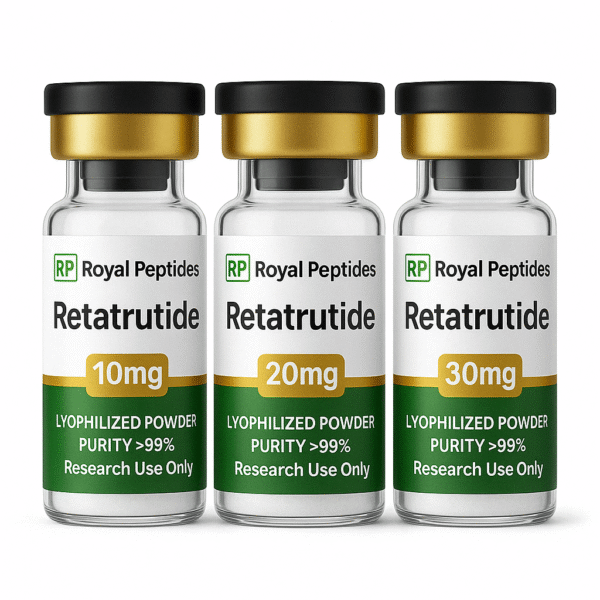 Retatrutide Single Vial
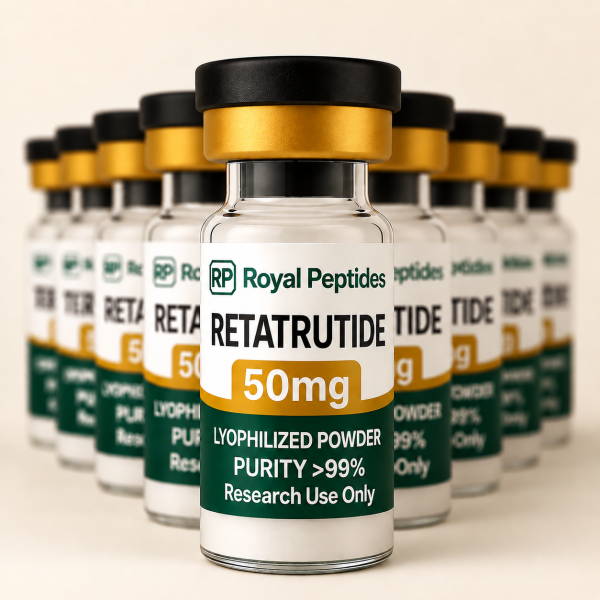 Retatrutide 10-Vial Bulk Kit RT