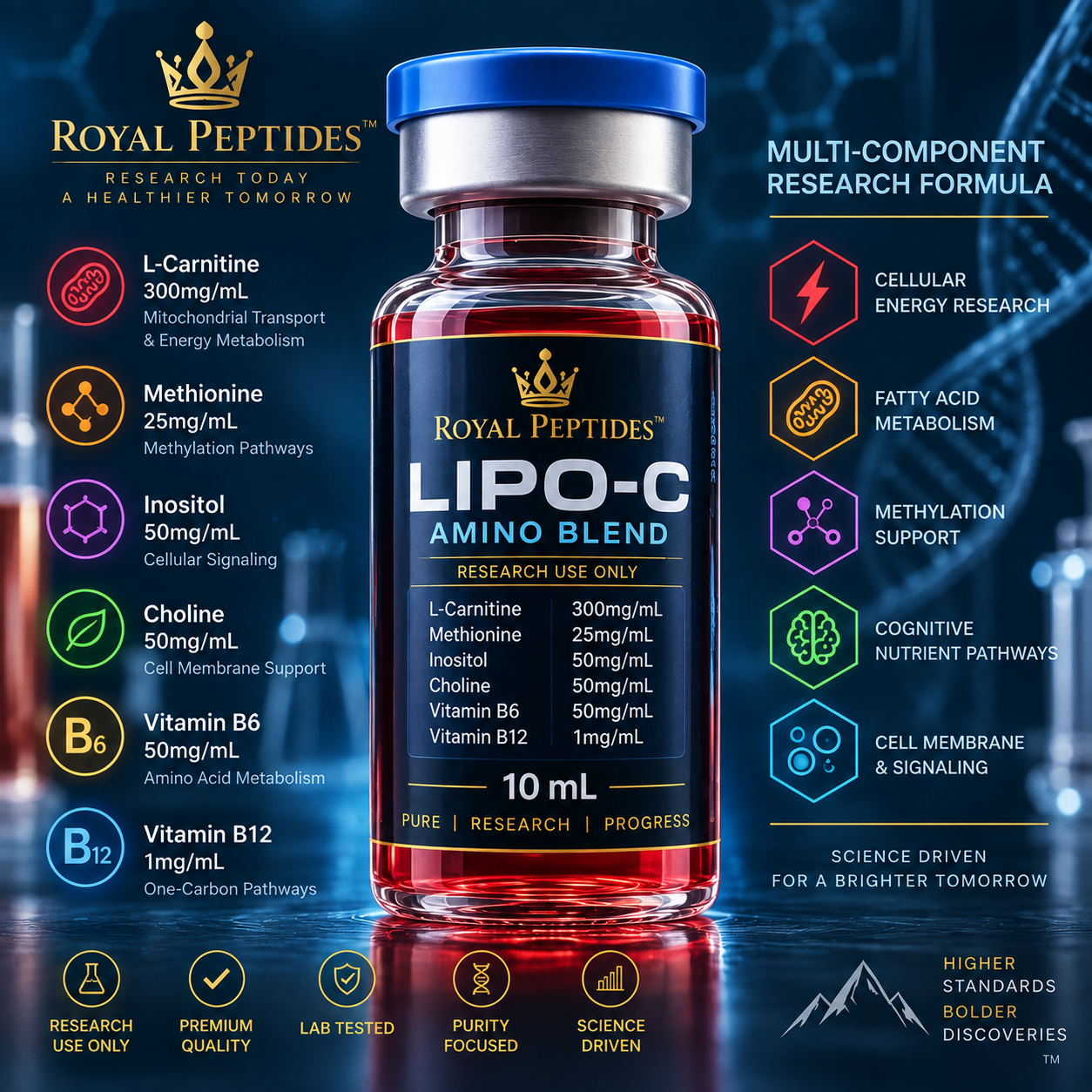
Multi-Component Research Formula
Lipo-C Amino Blend 10mL
Lipo-C Amino Blend is a concentrated,
multi-component research formulation combining
L-Carnitine, Methionine, Inositol, Choline,
Vitamin B6 and Vitamin B12.
Each milliliter contains 476mg of total listed active
ingredients across six components selected for biochemical,
nutrient-pathway and cellular metabolism research.
10mL Vial
6-Component Formula
476mg/mL Listed Actives
L-Carnitine 300mg/mL
Research Use Only
Volume
10mL
Components
6 Actives
Listed Actives
476mg/mL
Primary Component
L-Carnitine
What Is Lipo-C Amino Blend?
Lipo-C Amino Blend is a research formulation
built around a high concentration of L-Carnitine together with
methionine, inositol, choline and vitamins B6 and B12.
Rather than representing a single isolated compound, Lipo-C
provides researchers with a defined combination of amino-acid,
vitamin and nutrient-associated components for investigation
of interconnected biochemical pathways.
The formulation contains
300mg/mL L-Carnitine as its largest component,
accompanied by methionine, inositol, choline, pyridoxine
(Vitamin B6) and Vitamin B12.
These compounds are individually relevant to research involving
processes such as fatty-acid transport, amino-acid metabolism,
methyl-group biology, phospholipid pathways, cellular energy
metabolism and vitamin-dependent enzymatic reactions.
Research Formulation
References to the biological roles of individual nutrients describe
established biochemical functions or areas of scientific
investigation. They should not be interpreted as evidence that this
combined formulation treats disease, produces weight loss or has an
established therapeutic effect.
Complete Composition
Lipo-C Formula — Per 1mL
Each 1mL of the Lipo-C Amino Blend contains the following
stated formulation:
Total Listed Active Content
476mg per mL
4,760mg total listed active content across the complete
10mL vial.
300mg/mL
L-Carnitine Research
L-Carnitine is a naturally occurring
quaternary ammonium compound derived from the amino acids
lysine and methionine.
Its best-characterized biochemical role involves the
carnitine shuttle, which participates in the
transport of long-chain fatty acids into mitochondria where
they can undergo beta-oxidation.
Because of this function, L-Carnitine has been extensively
investigated in research concerning
mitochondrial biology, fatty-acid metabolism,
cellular energetics and metabolic biochemistry.
At 300mg per mL, L-Carnitine represents the
largest individual component of the Lipo-C formulation.
MIC Components
Methionine + Inositol + Choline
The formulation also incorporates the three components commonly
abbreviated as MIC: Methionine, Inositol and Choline.
Each participates in different areas of cellular and biochemical
research.
25mg/mL
Methionine
Methionine is an essential sulfur-containing amino acid.
It is also the metabolic precursor to
S-adenosylmethionine (SAM), an important methyl donor used
in numerous cellular methylation reactions.
Methionine therefore appears in research involving
amino-acid metabolism, methyl-group transfer,
sulfur-containing compounds and cellular biochemical
pathways.
50mg/mL
Inositol
Inositol is a naturally occurring carbocyclic sugar that
contributes to several cellular signaling systems.
Inositol-containing phospholipids participate in membrane
structure and intracellular signal-transduction pathways,
making inositol relevant to research in cellular signaling
and membrane biology.
50mg/mL
Choline
Choline is an essential nutrient and precursor used in the
synthesis of phosphatidylcholine, a major component of
cellular membranes.
Choline is also involved in acetylcholine synthesis and
participates indirectly in one-carbon metabolism through
its conversion to betaine.
Combined Research
MIC Pathway Research
Studying methionine, inositol and choline together provides
a multi-component model involving methylation,
phospholipid biology, nutrient metabolism and cellular
signaling.
Vitamin Components
Vitamin B6 + Vitamin B12
50mg/mL
Vitamin B6
Vitamin B6 refers to a group of related compounds whose
active coenzyme form, pyridoxal 5'-phosphate, participates
in numerous enzymatic reactions.
B6-dependent enzymes are particularly important in
amino-acid metabolism, including
transamination and decarboxylation reactions.
1mg/mL
Vitamin B12
Vitamin B12, or cobalamin, is a complex water-soluble
vitamin that functions as a cofactor in specific enzymatic
pathways.
B12 is widely studied in relation to
one-carbon metabolism, methylation-associated
pathways and cellular biochemical function.
Lipo-C Research Areas
The multi-component nature of the Lipo-C Amino Blend makes it
relevant to laboratory investigation across several overlapping
areas of biochemical research.
Mitochondrial Research
Investigation of L-Carnitine and mitochondrial fatty-acid
transport pathways.
Fatty-Acid Metabolism
Research involving the transport and biochemical processing
of long-chain fatty acids.
Amino-Acid Metabolism
Methionine and Vitamin B6 provide components relevant to
amino-acid biochemical pathways.
Methylation Biology
Methionine, choline and B-vitamin pathways intersect with
one-carbon and methyl-group metabolism.
Cellular Membranes
Choline and inositol are relevant to phospholipid and
membrane-associated research.
Cellular Signaling
Inositol-containing molecules participate in important
intracellular signaling systems.
Lipo-C Amino Blend Specifications
Product
Lipo-C Amino Blend
Vial Volume
10mL
L-Carnitine
300mg/mL
Methionine
25mg/mL
Inositol
50mg/mL
Choline
50mg/mL
Vitamin B6
50mg/mL
Vitamin B12
1mg/mL
Listed Actives
476mg/mL
Total Vial Content
4,760mg Listed Actives
Six-Component Formulation
Why Researchers Study Lipo-C Components
One of the distinguishing characteristics of Lipo-C is that it
brings several biochemically different components into a single
defined formulation.
L-Carnitine is closely associated with mitochondrial fatty-acid
transport, while methionine participates in amino-acid and
methyl-donor pathways. Choline contributes to phospholipid and
one-carbon biology, inositol is relevant to membrane-associated
signaling, and Vitamins B6 and B12 function as cofactors within
important biochemical reactions.
This creates a useful multi-component research material for
laboratory studies examining relationships among
nutrient metabolism, cellular energetics, amino-acid
biochemistry and intracellular signaling.
Lipo-C Amino Blend FAQ
What is Lipo-C Amino Blend?
Lipo-C Amino Blend is a six-component research formulation
containing L-Carnitine, Methionine, Inositol, Choline,
Vitamin B6 and Vitamin B12.
How much L-Carnitine is in Lipo-C?
The stated formulation contains 300mg of L-Carnitine per
milliliter.
What does MIC mean in a Lipo-C formulation?
MIC commonly refers to Methionine, Inositol and Choline,
three components included in this Lipo-C research blend.
What is the complete Lipo-C formula per mL?
Each milliliter contains L-Carnitine 300mg, Methionine 25mg,
Inositol 50mg, Choline 50mg, Vitamin B6 50mg and Vitamin B12
1mg, for 476mg of total listed active ingredients per mL.
How large is the Lipo-C vial?
The vial contains 10mL of the stated formulation.
How much total listed active content is in the 10mL vial?
At 476mg of listed active ingredients per mL, the complete
10mL vial contains 4,760mg of total listed active content.
What research areas are associated with L-Carnitine?
L-Carnitine is widely studied in connection with the
mitochondrial carnitine shuttle, long-chain fatty-acid
transport, cellular energetics and metabolic biochemistry.
Is Lipo-C Amino Blend intended for human use?
No. This product is supplied strictly as research material
and is not intended for human or veterinary use.
For Research Use Only
Lipo-C Amino Blend is supplied strictly for laboratory, analytical
and research purposes. It is not intended for human or veterinary
use, consumption, diagnosis, treatment, prevention or mitigation
of disease. References to fatty-acid metabolism, mitochondrial
function, methylation, cellular energy, amino-acid metabolism or
other biological processes describe established biochemical
functions or areas of scientific investigation and do not
constitute therapeutic, weight-loss or medical claims.



 Lipo-C Amino Bioboost Blend