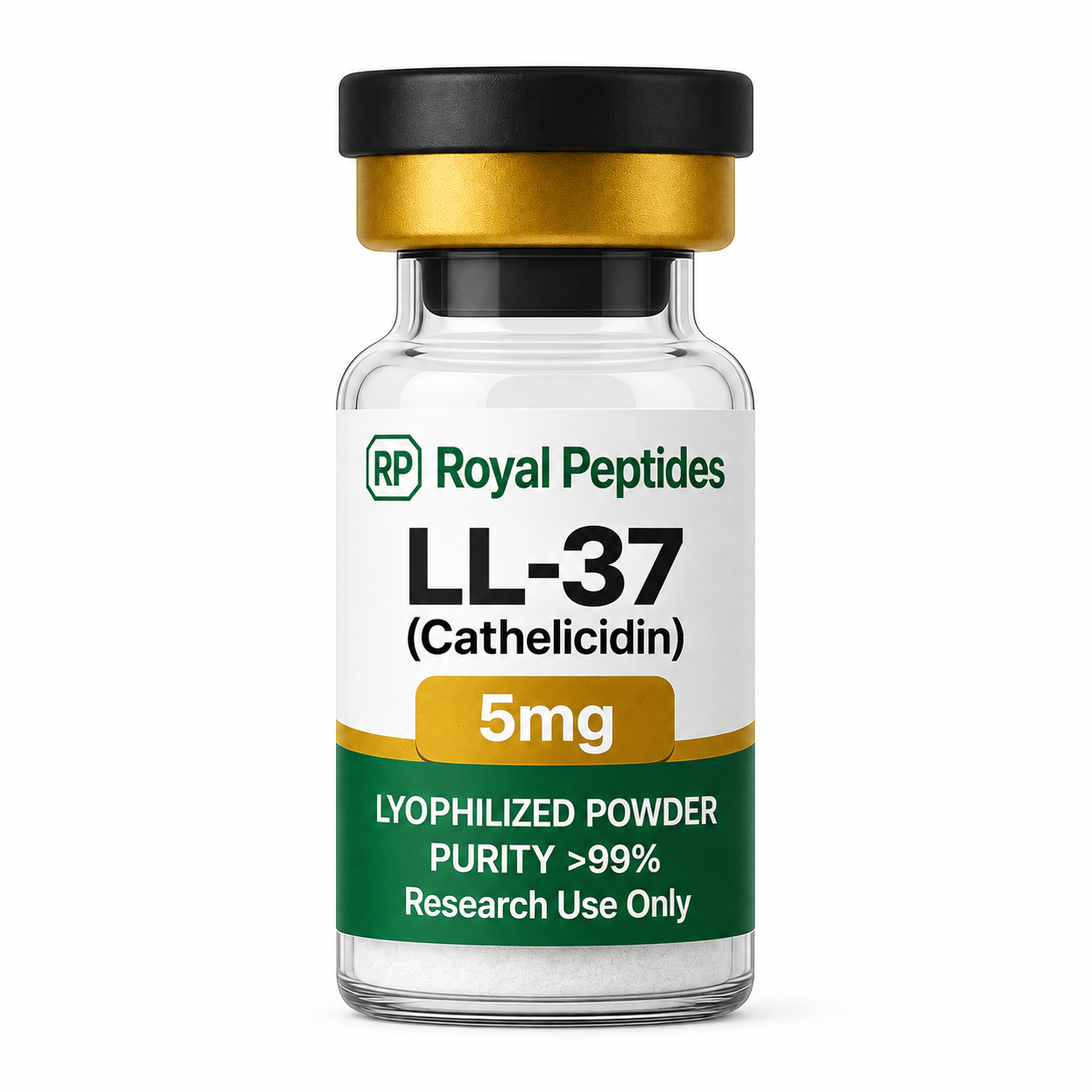
Human Cathelicidin Research Peptide • Research Use Only
LL-37 Peptide 5mg — Cathelicidin Research Dossier
LL-37 peptide is a naturally occurring
37-amino-acid human cathelicidin-derived peptide
extensively investigated in innate immunity, antimicrobial activity,
microbial membrane interactions, biofilm biology, inflammatory
signaling and tissue-response research.
Research Compound
LL-37
Research Format
5mg
Peptide Length
37 Amino Acids
Classification
Cathelicidin
What Is LL-37 Peptide?
LL-37 is the principal human cathelicidin
antimicrobial peptide. It is generated through proteolytic processing
of the human cathelicidin precursor protein
hCAP18, which is encoded by the
CAMP gene.
The name LL-37 refers to two defining structural characteristics:
the mature peptide begins with two leucine residues
(LL) and consists of
37 amino-acid residues.
LL-37 has attracted substantial research interest because its
biological activity extends beyond direct interactions with
microorganisms. Experimental studies have examined its involvement
in innate immune signaling, inflammatory responses,
chemotaxis, membrane biology and tissue-response pathways.
LL-37 Amino-Acid Sequence and Structure
LL-37 is a cationic peptide containing 37 amino-acid residues.
Its positive charge and amphipathic characteristics are important
areas of research because they influence interactions between the
peptide and biological membranes.
LLGDFFRKSKEKIGKEFKRIVQRIKDFLRNLVPRTES
In membrane-associated environments, LL-37 can adopt an
alpha-helical conformation. Researchers have
investigated how this structural behavior contributes to
peptide-membrane interactions and other biological functions.
LL-37, hCAP18 and the CAMP Gene
LL-37 does not initially exist as an isolated 37-residue peptide
inside human cells. It originates from the larger precursor protein
human cationic antimicrobial protein 18 (hCAP18).
hCAP18 is encoded by the CAMP gene. Enzymatic
processing releases the C-terminal LL-37 sequence from the precursor,
producing the mature peptide studied extensively in innate-immunity
research.
CAMP Gene
Encodes the human cathelicidin antimicrobial peptide precursor.
hCAP18
Precursor protein from which mature LL-37 can be released.
LL-37
37-residue mature peptide investigated across innate immune and
antimicrobial research.
LL-37 Antimicrobial Peptide Research
LL-37 is widely classified as an
antimicrobial peptide (AMP). A major area of
laboratory research involves its interaction with microbial
membranes.
Because LL-37 is both cationic and amphipathic, investigators have
examined how electrostatic and hydrophobic interactions influence
its association with lipid membranes.
Experimental studies have evaluated LL-37 against numerous
microorganisms under controlled laboratory conditions, including
models involving Gram-positive bacteria, Gram-negative
bacteria and fungal organisms.
Research Context
Antimicrobial activity observed in laboratory experiments does not
mean LL-37 is an approved antimicrobial drug or treatment for an
infection.
LL-37 and Biofilm Research
LL-37 biofilm research is another important area
of antimicrobial-peptide investigation.
Biofilms are structured microbial communities in which cells exist
within a self-produced extracellular matrix. Their biology differs
considerably from freely suspended microbial cells, making biofilms
an important model for studying microbial organization, signaling
and environmental persistence.
Researchers have examined LL-37 in experimental biofilm systems to
investigate effects on processes such as
surface attachment, microbial communication, biofilm
development and membrane-associated activity.
These studies help researchers better understand the broader role
antimicrobial peptides may play in host-microbe interactions.
LL-37 and Innate Immunity Research
LL-37 is an important research target in
innate immunity, the collection of rapid biological
defense mechanisms that respond to environmental and microbial
signals.
Human cells associated with barrier tissues and immune responses can
express cathelicidin-related molecules. This has led researchers to
investigate LL-37 not simply as an antimicrobial peptide, but as a
signaling molecule operating at the intersection of
host defense, inflammation and cellular communication.
Host-Defense Research
LL-37 is studied as part of the endogenous peptide systems
associated with early innate immune responses.
Immune-Cell Signaling
Experimental research has examined interactions between LL-37
and signaling pathways involved in immune-cell recruitment and
cellular communication.
LL-37 and Immunomodulatory Signaling
One reason LL-37 remains an active research subject is that its
biological behavior appears more complex than simple direct
antimicrobial activity.
Experimental research has examined interactions involving
chemotactic signaling, cytokine-associated pathways,
immune-cell recruitment and receptor-mediated cellular
communication.
These observations have contributed to LL-37 being studied as an
immunomodulatory peptide as well as an antimicrobial
peptide.
Innate Immunity
Cathelicidin
CAMP
hCAP18
Chemotaxis
Cell Signaling
Host Defense
LL-37 and Inflammation Research
The relationship between LL-37 and inflammatory
signaling is complex and context dependent.
Researchers have investigated LL-37 in models examining inflammatory
mediators, immune-cell behavior, cellular stress and interactions
between innate immune signaling pathways.
Depending on the experimental system, concentration, cellular
environment and other variables, LL-37-associated responses may
differ substantially. This makes the peptide particularly useful for
mechanistic research into the regulation of inflammatory biology.
LL-37 and Tissue-Response Research
LL-37 has also been investigated in experimental models involving
epithelial biology, keratinocytes, fibroblasts, endothelial
cells and tissue-response signaling.
Laboratory studies have examined processes associated with cellular
migration, barrier biology, angiogenic signaling and communication
between immune and structural cells.
This area of research is often discussed in relation to
wound-response biology. Such research describes experimental
mechanisms and should not be interpreted as evidence that an LL-37
research product heals wounds or treats tissue injuries.
LL-37 Research Areas
Antimicrobial Research
Laboratory investigation of LL-37 interactions with microbial
membranes and antimicrobial peptide mechanisms.
Biofilm Biology
Research involving microbial attachment, biofilm development
and peptide interactions with structured microbial communities.
Innate Immune Signaling
Investigation of LL-37 within endogenous host-defense and
immune-cell signaling systems.
Inflammatory Biology
Experimental analysis of context-dependent interactions between
LL-37 and inflammatory signaling pathways.
Membrane Research
Investigation of how the cationic and amphipathic structure of
LL-37 influences interactions with lipid membranes.
Cellular Response Research
Studies involving epithelial cells, fibroblasts, endothelial
cells and other cellular models associated with tissue responses.
LL-37 5mg Research Specifications
Compound
LL-37
Product Format
5mg
Classification
Human Cathelicidin Peptide
Peptide Length
37 Amino Acids
Precursor
hCAP18
Gene
CAMP
Research Class
Antimicrobial Peptide
Form
Lyophilized Research Material
Why Is LL-37 Studied?
LL-37 is scientifically interesting because a single endogenous
peptide participates in several interconnected areas of biological
research.
Its cationic amphipathic structure makes it valuable for
membrane and antimicrobial peptide research, while
its endogenous role as a human cathelicidin makes it relevant to
innate immune and host-defense biology.
At the same time, research involving inflammatory signaling,
chemotaxis, cellular migration and tissue responses demonstrates why
LL-37 is often studied as a multifunctional signaling peptide rather
than exclusively as an antimicrobial molecule.
LL-37 Peptide FAQ
What is LL-37 peptide?
LL-37 is a 37-amino-acid human cathelicidin-derived peptide studied
extensively in antimicrobial, innate immunity, inflammatory
signaling, biofilm and cellular-response research.
What does LL-37 stand for?
The name refers to the two leucine residues at the beginning of the
mature peptide sequence, represented by LL, and its total length of
37 amino-acid residues.
Is LL-37 an antimicrobial peptide?
Yes. LL-37 is widely classified as a human antimicrobial peptide
and has been extensively investigated in laboratory models involving
microbial membranes and host-defense biology.
What is the LL-37 amino-acid sequence?
The 37-amino-acid LL-37 sequence is
LLGDFFRKSKEKIGKEFKRIVQRIKDFLRNLVPRTES.
What is hCAP18?
hCAP18 is the human cathelicidin precursor protein from which the
mature LL-37 peptide is released through proteolytic processing.
What is the CAMP gene?
CAMP is the gene that encodes the human cathelicidin antimicrobial
peptide precursor associated with hCAP18 and LL-37.
Why is LL-37 studied in biofilm research?
Researchers have investigated LL-37 in experimental biofilm systems
to study microbial attachment, biofilm development, membrane
interactions and other aspects of host-microbe biology.
Is LL-37 approved for human use?
LL-37 research material is not an approved medication. Royal
Peptides supplies LL-37 5mg strictly for laboratory, analytical and
research purposes.
For Research Use Only
LL-37 5mg is supplied strictly for laboratory, analytical and research
purposes. It is not intended for human or veterinary use, consumption,
diagnosis, treatment, prevention or mitigation of disease. References
to antimicrobial activity, immunity, inflammation, biofilms or
tissue-response pathways describe areas of scientific investigation
and do not represent therapeutic claims.



 LL-37 Kit