Peptide bioregulators: seven research peptides, one place
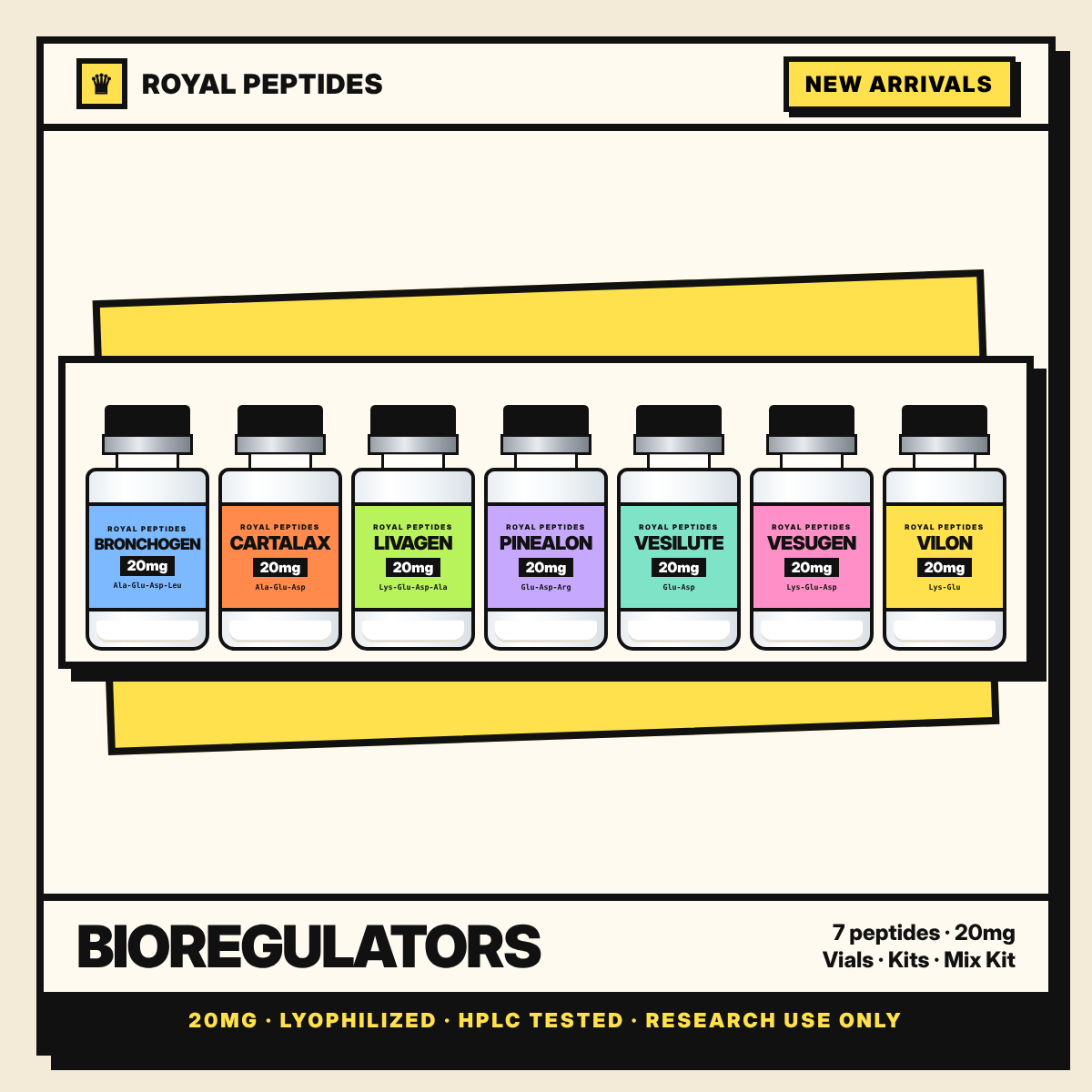
Royal Peptides now stocks seven research-grade peptide bioregulators: Bronchogen, Cartalax, Livagen, Pinealon, Vesilute, Vesugen and Vilon. Each comes as a 20mg lyophilized vial, HPLC-tested with a COA for every lot. Choose your peptide and pack size above: a single vial ($65), a 10-vial kit ($550, just $55 per vial), or the Mix Kit with one vial of all seven ($399).
What are peptide bioregulators?
Peptide bioregulators are ultra-short peptides, just 2 to 4 amino acids long. They were first isolated from specific animal organs and tissues and are now made synthetically to an exact sequence. The field was founded by Prof. Vladimir Khavinson and colleagues at the St. Petersburg Institute of Bioregulation and Gerontology, and they are often called Khavinson peptides.
- Ultra-short chains: di-, tri- and tetrapeptides, small enough that researchers study whether they can reach the cell nucleus.
- Tissue-specific: each sequence is linked to one tissue, such as bronchial, cartilage, liver, neural, bladder, vascular or thymic.
- Gene-level signalling: studied for how they may interact with DNA and chromatin to affect gene expression, rather than acting on receptors.
Most published work is preclinical and comes mainly from one research school. Independent data is still limited.
Bioregulator comparison
| Peptide |
Sequence |
Class |
Tissue focus |
| Bronchogen |
Ala-Glu-Asp-Leu |
Tetrapeptide |
Bronchial and respiratory tissue |
| Cartalax |
Ala-Glu-Asp |
Tripeptide |
Cartilage and connective tissue |
| Livagen |
Lys-Glu-Asp-Ala |
Tetrapeptide |
Hepatic tissue and chromatin |
| Pinealon |
Glu-Asp-Arg |
Tripeptide |
Neural and brain tissue |
| Vesilute |
Glu-Asp |
Dipeptide |
Bladder and urogenital tissue |
| Vesugen |
Lys-Glu-Asp |
Tripeptide |
Vascular and endothelial tissue |
| Vilon |
Lys-Glu |
Dipeptide |
Thymic and immune tissue |
The seven bioregulators
Bronchogen 20mg: bronchial bioregulator
Sequence: Ala-Glu-Asp-Leu (AEDL peptide) · Formula: C18H30N4O9 · MW: 446.46 g/mol
Bronchogen is a synthetic tetrapeptide bioregulator (Ala-Glu-Asp-Leu) from the Khavinson series of short tissue-specific peptides. It was developed from research into peptide complexes isolated from bronchial mucosa. Bronchogen has been studied mainly in cell and rodent models of the bronchial epithelium. Published work from the St. Petersburg Institute of Bioregulation and Gerontology has looked at how it may influence epithelial differentiation markers and the gene expression of airway lining cells. Like other bioregulators, it is investigated as a possible gene-level signalling molecule rather than a receptor agonist.
Cartalax 20mg: cartilage bioregulator
Sequence: Ala-Glu-Asp (AED peptide) · Formula: C12H19N3O8 · MW: 333.30 g/mol
Cartalax is a synthetic tripeptide bioregulator (Ala-Glu-Asp) from the Khavinson series, associated with cartilage and connective tissue. Its link to cartilage comes from the Khavinson group, which patented Ala-Glu-Asp for bone and cartilage tissue metabolism. Most of the published lab work is in other cell types. In ageing skin fibroblasts, AED raised the cell-division marker Ki-67, reduced the matrix-degrading enzyme MMP-9 and suppressed caspase-dependent apoptosis (Lin’kova et al., 2016), and it has also been studied in kidney tissue cultures. Nearly all of this research comes from one group and has not been independently replicated.
Livagen 20mg: liver bioregulator
Sequence: Lys-Glu-Asp-Ala (KEDA peptide) · Formula: C18H31N5O9 · MW: 461.47 g/mol
Livagen is a synthetic tetrapeptide bioregulator (Lys-Glu-Asp-Ala) from the Khavinson series, associated with liver tissue. Livagen is best known in the literature for chromatin research. Studies on lymphocytes from older donors reported that it may decondense heterochromatin, the tightly packed DNA that tends to build up with cellular ageing, and so make silenced genes accessible again. It has also been examined in hepatic tissue and enzyme-activity models.
Pinealon 20mg: neural bioregulator
Sequence: Glu-Asp-Arg (EDR peptide) · Formula: C15H26N6O8 · MW: 418.41 g/mol
Pinealon is a synthetic tripeptide bioregulator (Glu-Asp-Arg) from the Khavinson series, associated with neural tissue. Pinealon has been studied in neuronal cell cultures, including cerebellar granule cells exposed to oxidative stress, where researchers measured reactive oxygen species and cell viability. It has also appeared in rodent studies of prenatal hypoxia. Its very small size has made it a model compound for studying whether short peptides can reach the cell nucleus and interact with DNA.
Vesilute 20mg: bladder bioregulator
Sequence: Glu-Asp (ED dipeptide) · Formula: C9H14N2O7 · MW: 262.22 g/mol
Vesilute is a synthetic dipeptide bioregulator (Glu-Asp) from the Khavinson series, associated with bladder and urogenital tissue. Vesilute belongs to the group of peptides developed from research on bladder tissue extracts. As one of the smallest bioregulators, just two amino acids, it is studied in urogenital tissue and cell models. Most of the published work is in Russian-language literature, and independent data is limited.
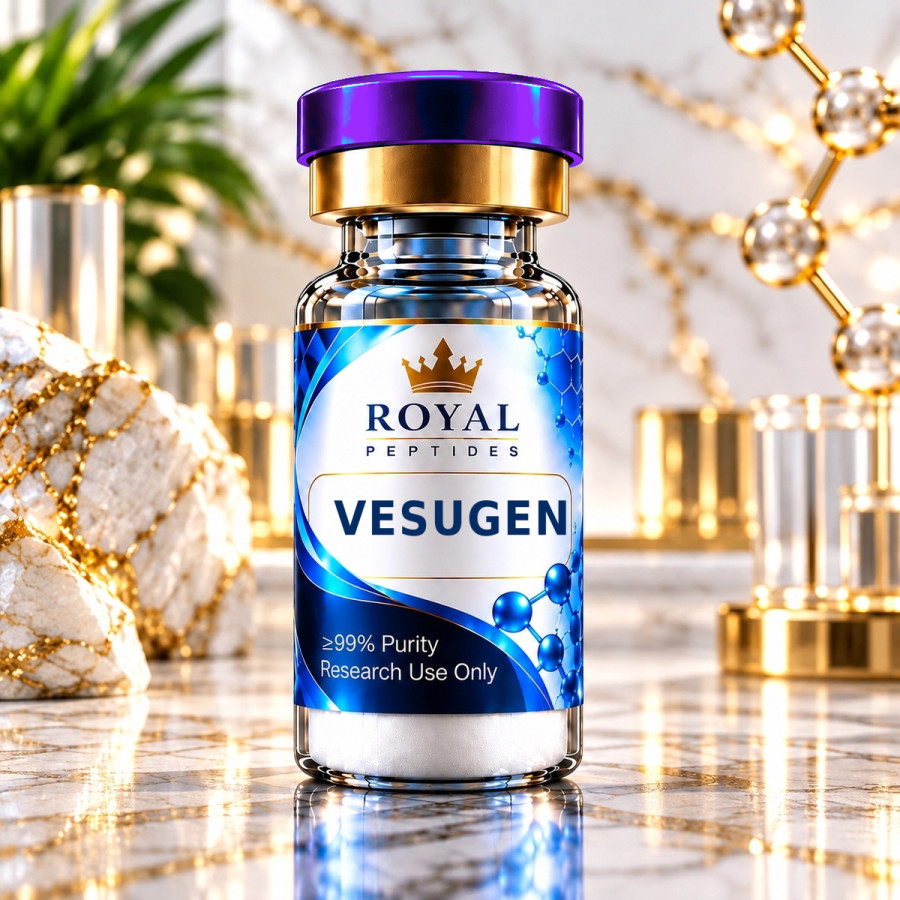
Vesugen 20mg: vascular bioregulator
Sequence: Lys-Glu-Asp (KED peptide) · Formula: C15H26N4O8 · MW: 390.39 g/mol
Vesugen is a synthetic tripeptide bioregulator (Lys-Glu-Asp) from the Khavinson series, associated with the vascular wall. Vesugen has been studied in vascular endothelial cell models, the cells lining blood vessels, including work on markers of cellular ageing and proliferation in cultured vascular cells. It is used as a research tool for exploring how tissue-specific short peptides may affect gene expression in the vascular system.
Vilon 20mg: thymic bioregulator
Sequence: Lys-Glu (KE dipeptide) · Formula: C11H21N3O5 · MW: 275.31 g/mol
Vilon is a synthetic dipeptide bioregulator (Lys-Glu) and one of the earliest compounds in the Khavinson series. It was developed from research on thymus-derived peptide preparations. Vilon is among the most-cited bioregulators. It has been used in gene-expression microarray studies, in chromatin research, and in rodent work on thymic and immune parameters and lifespan. Because it is so short, it is often used as a reference compound when comparing how different short peptides affect gene expression.
Formats and pricing
| Option |
Contents |
Price |
Per vial |
| Single Vial |
1 x 20mg of your chosen peptide |
$65 |
$65 |
| 10-Vial Kit |
10 x 20mg of one peptide, same batch |
$550 |
$55 (save $100) |
| Mix Kit |
1 x 20mg each of all seven bioregulators |
$399 |
~$57 (save $56) |
Specifications
| Amount |
20mg per vial |
| Form |
Lyophilized (freeze-dried) powder |
| Purity |
HPLC-verified, see batch COA |
| Testing |
Third-party tested, COA on every lot |
Storage and handling
Store lyophilized bioregulators at -20°C for long-term stability, or at 2–8°C for short-term storage. Keep them away from light and moisture. Let vials reach room temperature before opening.
Peptide bioregulator FAQ
Which bioregulator should I choose?
Each peptide is linked to a different tissue. Use the comparison table above to match a peptide to your research model, or choose the Mix Kit to work with all seven.
Are these peptides for human use?
No. All bioregulators are sold strictly for laboratory and in-vitro research.
What is the difference between a 10-vial kit and the Mix Kit?
The 10-vial kit has ten vials of one peptide. The Mix Kit has one vial each of all seven.
Where can I find COAs?
On our Lab Reports page, or on request from support.
For research use only. This product is sold only for laboratory and in-vitro research. It is not for human or veterinary use, and not for use as a drug, food, cosmetic or dietary supplement. These statements have not been evaluated by the FDA. This product is not intended to diagnose, treat, cure or prevent any disease. The research summaries above describe published preclinical literature and are not claims of effect. Buyers must be 21 or older.