 ARA-290 Peptide (Cibinetide)
 Price range: $485 through $620Select options
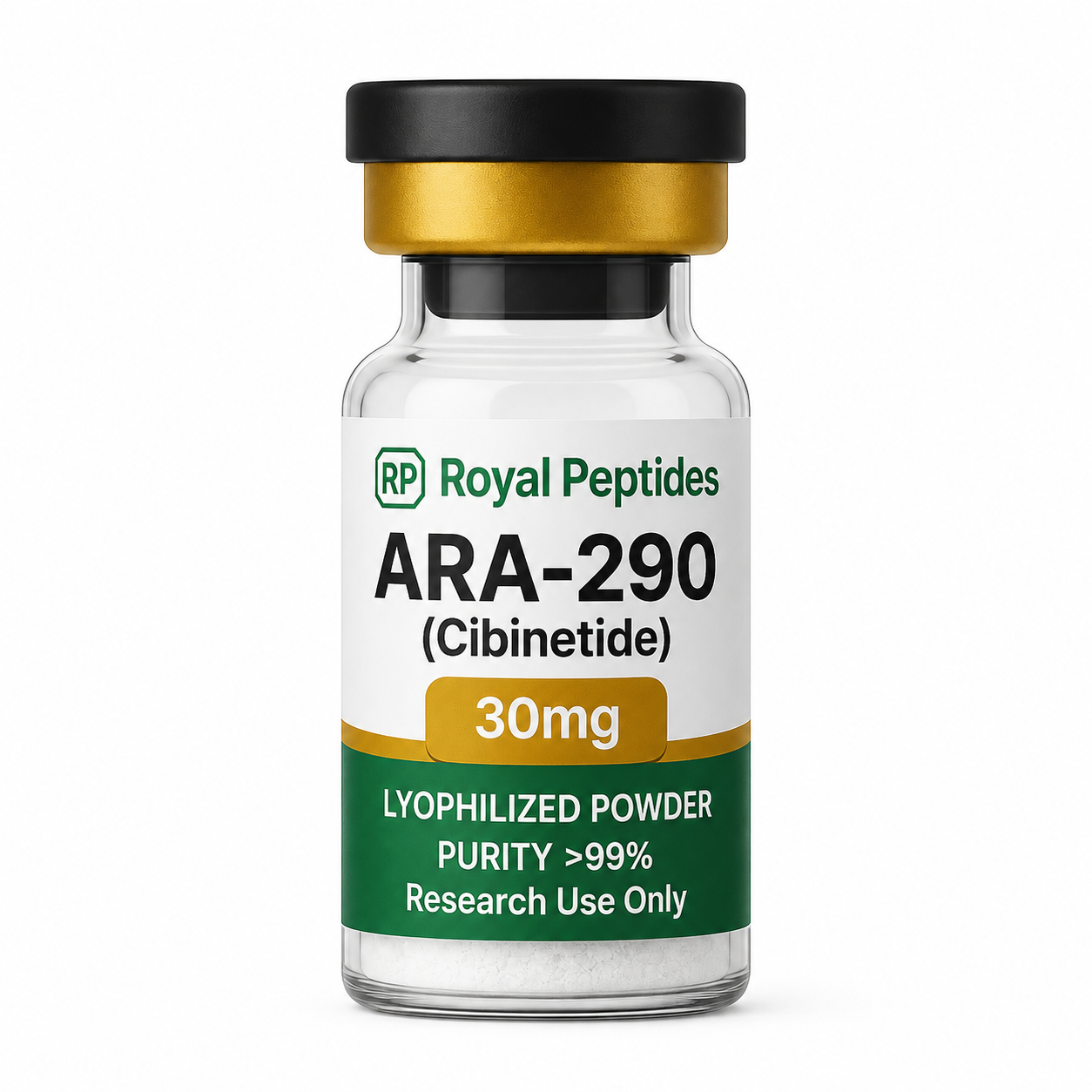
Royal Peptides products are offered exclusively for laboratory research, analytical, and scientific applications. Not for human or veterinary use.
Royal Peptides supplies compounds intended for controlled laboratory research and analytical applications.
Where applicable, Royal Peptides research materials are supplied in lyophilized form.
Lyophilization is a freeze-drying process used to remove moisture from material under controlled conditions.
Storage requirements may vary by compound, formulation, and production lot. Refer to the product label and available product-specific documentation.
Packaging components may vary slightly between production lots. This can include vial closures, cap styles, label positioning, and external packaging.
ARA-290 peptide, also known as cibinetide, is a synthetic peptide derived from a tissue-protective region of erythropoietin (EPO). It has been investigated in preclinical and clinical research involving innate repair receptor signaling, inflammatory pathways, tissue-protective mechanisms, small nerve fibers and neuropathy-related endpoints.
ARA-290 (cibinetide) is an 11-amino-acid synthetic peptide developed from the three-dimensional structure of erythropoietin. Research into the compound has focused on separating EPO-associated tissue-protective signaling from the classical erythropoietic activity responsible for stimulating red blood-cell production.
This distinction has made ARA-290 particularly interesting to researchers investigating how EPO-related signaling pathways may participate in cellular stress responses, inflammation, tissue protection and repair-associated biology without reproducing the conventional hematopoietic activity of EPO.
ARA-290 later became widely referenced in scientific literature as cibinetide.
A central area of ARA-290 research involves a receptor complex frequently referred to as the innate repair receptor (IRR).
The IRR has been described as a heteromeric receptor involving the erythropoietin receptor and the beta common receptor (βcR / CD131). Research has investigated activation of this pathway during tissue stress, injury and inflammatory signaling.
Investigators have used ARA-290 as a research tool for studying signaling associated with cellular survival, inflammatory regulation and tissue-response mechanisms.
ARA-290 originated from research examining the biological activities of erythropoietin. EPO is best known for its role in erythropoiesis, but research has also explored signaling associated with tissue stress and cellular protection.
Full-length erythropoietin is a glycoprotein hormone with a well-characterized role in stimulating red blood-cell production through classical erythropoietin receptor signaling.
ARA-290 was designed as a small EPO-derived peptide for investigating tissue-protective receptor pathways without the classical erythropoietic activity associated with full-length EPO.
ARA-290 has been investigated across several areas of experimental and translational research. These studies examine biological mechanisms and research endpoints rather than establishing approved medical uses.
Research has examined ARA-290 in experimental systems involving inflammatory signaling and innate repair receptor-associated pathways during cellular and tissue stress.
Cibinetide has been investigated in studies involving peripheral nerve biology, small nerve fibers and sensory-function research endpoints.
Preclinical investigations have explored ARA-290 in models of tissue stress and injury to better understand EPO-derived tissue-protective signaling mechanisms.
ARA-290 provides researchers with a defined peptide for examining receptor pathways associated with cellular stress responses, survival signaling and repair-associated biology.
One of the better-known areas of cibinetide research involves small fiber neuropathy. Clinical research has investigated ARA-290 in populations with disorders associated with small nerve-fiber dysfunction.
Researchers have evaluated endpoints involving small nerve-fiber structure, sensory function and patient-reported outcomes to examine the biological effects associated with innate repair receptor signaling.
These investigations are important scientifically because they extend ARA-290 research beyond isolated cell systems into controlled human research environments while continuing to examine its underlying biological mechanisms.
Another major area of scientific interest involves the relationship between ARA-290 and inflammatory signaling.
Tissue injury and cellular stress can activate complex inflammatory signaling networks. Research into the innate repair receptor has examined whether EPO-derived signaling can influence these responses while simultaneously participating in tissue-protective mechanisms.
ARA-290 therefore provides a useful experimental compound for investigating the intersection between inflammatory biology, cellular stress responses and repair-associated signaling.
ARA-290 is considerably smaller than full-length erythropoietin. Its 11-amino-acid structure was developed to reproduce specific structural characteristics associated with the tissue-protective region of EPO.
The compact structure allows researchers to investigate a defined EPO-derived signaling sequence independently from the much larger parent glycoprotein.
ARA-290 occupies an interesting position in peptide research because it was designed around a specific biological question: can tissue-protective EPO signaling be investigated independently of EPO's classical hematopoietic activity?
This has led researchers to examine cibinetide across models involving innate repair receptor activation, inflammatory signaling, peripheral nerve biology, tissue stress and cellular repair mechanisms.
ARA-290 also illustrates how researchers can derive small, functionally focused peptide sequences from substantially larger biological signaling molecules.
ARA-290 is an 11-amino-acid synthetic peptide derived from structural research involving erythropoietin. It has been investigated primarily for its interaction with tissue-protective and innate repair receptor-associated signaling pathways.
Yes. Cibinetide is the name commonly used in scientific literature for the investigational peptide originally known as ARA-290.
No. Erythropoietin is a much larger glycoprotein hormone. ARA-290 is a small synthetic peptide derived from structural research into a tissue-protective region associated with EPO.
The innate repair receptor is a receptor complex studied in connection with tissue stress and protective signaling. Research literature commonly describes it as involving the erythropoietin receptor together with the beta common receptor, also known as CD131.
ARA-290 has been investigated in research involving innate repair receptor signaling, inflammation, tissue-protective mechanisms, peripheral nerve biology, small nerve fibers and cellular stress responses.
Yes. Cibinetide has been investigated in human clinical research, including studies examining small fiber neuropathy-related endpoints. Clinical investigation does not establish regulatory approval or therapeutic efficacy.
ARA-290 was specifically developed for research into tissue-protective EPO-related signaling without reproducing the classical erythropoietic activity of full-length erythropoietin.
No. ARA-290 / cibinetide is an investigational research compound and is not an approved medication. Royal Peptides supplies this material strictly for laboratory research purposes.
Product information pulled directly from WooCommerce.
Review available analytical documentation for the applicable product and batch.
View Analytical Documentation →Match available documentation to the applicable research material and batch.
Review the analytical information provided for the selected batch where available.
Keep relevant product and batch documentation with your research records.
Shipping options and delivery estimates are shown at checkout. Refer to the product label and applicable documentation for handling and storage information.
Complete payment using the available methods presented during checkout.
Tracking information is provided when available for the selected delivery service.
Use the product label and applicable documentation for handling and storage guidance.


 ARA-290 Peptide (Cibinetide)ARA-290 Peptide (Cibinetide)
PREMIUM RESEARCH MATERIALS
You must be at least 21 years old to enter. All products are intended strictly for laboratory research only — not for human or veterinary use or consumption.
INDEPENDENT RESEARCH • QUALITY • TRANSPARENCY
Verification remembered for 30 days