


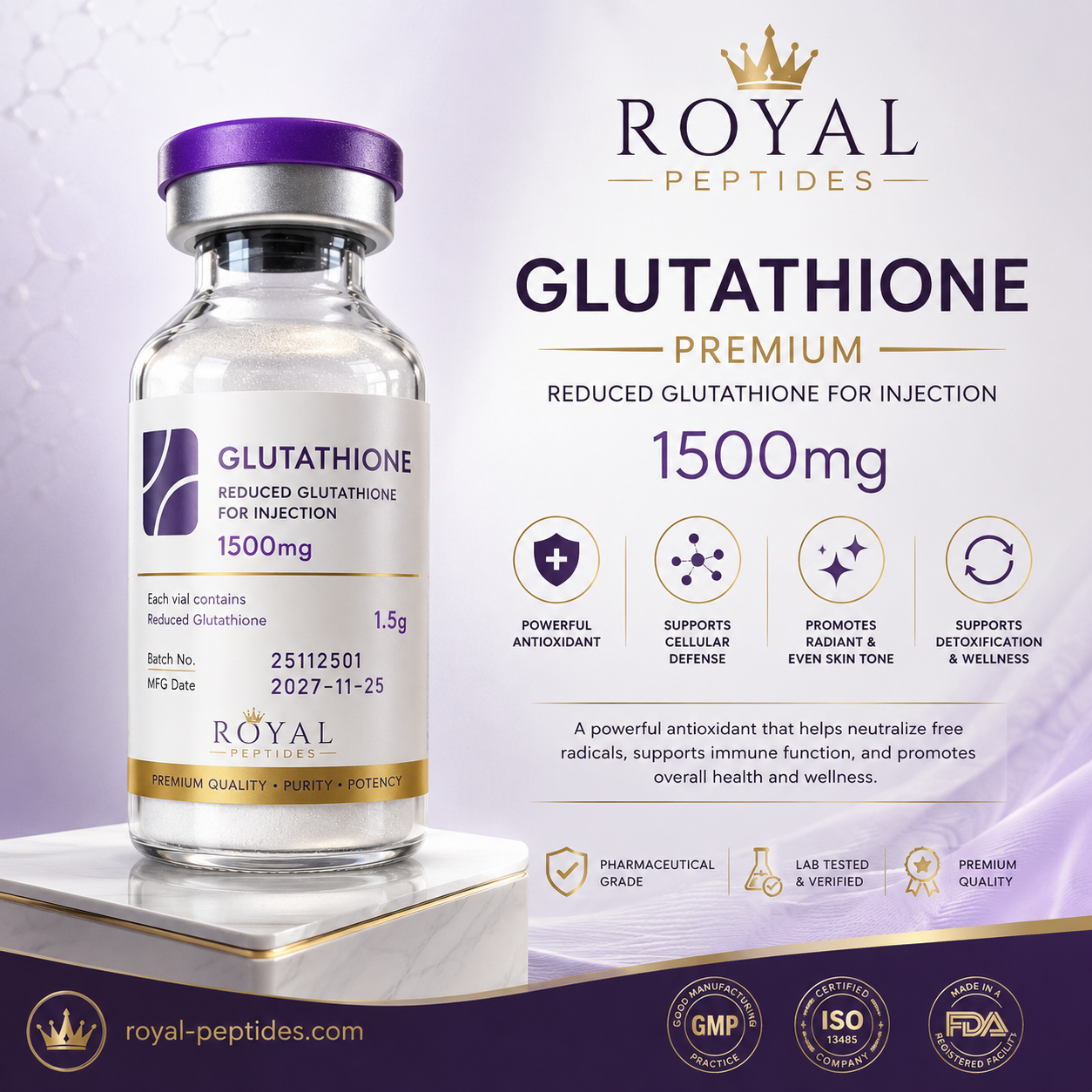
 Glutathione Peptide
 Price range: $65 through $485Select options
Royal Peptides products are offered exclusively for laboratory research, analytical, and scientific applications. Not for human or veterinary use.
Royal Peptides supplies compounds intended for controlled laboratory research and analytical applications.
Where applicable, Royal Peptides research materials are supplied in lyophilized form.
Lyophilization is a freeze-drying process used to remove moisture from material under controlled conditions.
Storage requirements may vary by compound, formulation, and production lot. Refer to the product label and available product-specific documentation.
Packaging components may vary slightly between production lots. This can include vial closures, cap styles, label positioning, and external packaging.
Glutathione is a naturally occurring tripeptide composed of glutamate, cysteine, and glycine. It is extensively characterized in biochemical research and supplied by Royal Peptides exclusively for controlled laboratory, analytical, and scientific research.
Not for human or veterinary use, administration, ingestion, injection, compounding, diagnostic, therapeutic, clinical, or personal use.
Glutathione is a naturally occurring tripeptide constructed from three amino-acid residues: glutamate, cysteine, and glycine. It is commonly abbreviated as GSH when referring to its reduced form.
The molecule is extensively characterized in biochemical literature and is studied across analytical chemistry, redox biology, enzymology, molecular biology, and cellular research.
Royal Peptides supplies glutathione strictly as a laboratory research material. References to biochemical functions or scientific literature are provided for compound identification and research context only.
Glutathione consists of three amino-acid components arranged within a defined tripeptide structure. Its molecular composition and redox chemistry make it a widely investigated biochemical research material.
Glutathione's tripeptide structure incorporates glutamate, cysteine, and glycine. Each component contributes to the molecular identity of the complete glutathione molecule.
One of the three amino-acid components forming the defined molecular structure of glutathione.
The cysteine residue contains the thiol group central to the redox chemistry investigated in glutathione research.
The third amino-acid component incorporated into the tripeptide structure of glutathione.
Together, the three amino-acid residues form the molecular structure identified as glutathione.
Glutathione has a well-established biochemical identity and is investigated across multiple laboratory disciplines. These research contexts describe areas of scientific study rather than intended uses of this product.
Glutathione is extensively investigated in experimental systems examining oxidation-reduction chemistry and thiol-dependent molecular reactions.
Laboratory studies may investigate relationships between reduced glutathione (GSH) and its oxidized disulfide form (GSSG).
Glutathione is studied in connection with characterized enzyme systems and biochemical reactions involving glutathione-dependent molecular processes.
Researchers may investigate glutathione concentration, molecular state, redox relationships, and associated analytical characteristics in controlled laboratory systems.
Laboratory evaluation should rely on documentation associated with the specific production lot being investigated. General product-page information should not replace applicable batch-specific analytical records.
Maintaining clear material records helps laboratories associate analytical observations with the specific glutathione production lot incorporated into an experimental workflow.
Record the compound identity, stated material quantity, applicable production lot or batch reference, date received, and internal laboratory reference information.
Preserve applicable analytical documentation, laboratory observations, experimental results, storage records, and other research documentation associated with the material.
Glutathione research material should be handled using appropriate laboratory procedures designed to maintain material identity, experimental integrity, and traceability.
Handle using appropriate laboratory practices and equipment. Maintain clear material identification throughout receipt, storage, analytical preparation, and experimental workflows.
Follow storage information associated with the applicable product label and batch documentation. Maintain appropriate laboratory storage and material-control records.
Royal Peptides glutathione is supplied exclusively as a laboratory research material. It is not offered or represented as a medicine, pharmaceutical preparation, dietary supplement, food, cosmetic, or consumer health product.
Glutathione is a naturally occurring tripeptide composed of glutamate, cysteine, and glycine. It is extensively characterized in biochemical research.
Glutathione is specifically classified as a tripeptide because its molecular structure contains three amino-acid residues.
GSH is the commonly used biochemical abbreviation for reduced glutathione.
GSSG refers to glutathione disulfide, the oxidized form commonly studied alongside reduced glutathione in laboratory redox research.
Scientific research involving glutathione includes areas such as redox chemistry, thiol chemistry, enzymology, molecular biology, and analytical investigation of GSH/GSSG systems. These are research contexts rather than intended uses of this product.
No. Royal Peptides supplies this material strictly for laboratory research. It is not intended for human or veterinary administration.
No. Royal Peptides does not provide dosing, administration, injection, prescribing, treatment, or personal-use instructions for this research material.
Batch-specific analytical documentation corresponds to a particular production lot. Recording the applicable lot reference supports traceability between the research material, analytical documentation, and laboratory records.
Batch-specific analytical documentation may be available for the applicable production lot. Researchers should review documentation corresponding to the specific material received.
Glutathione is supplied for laboratory research use only. Not for human or veterinary use. Not intended for administration, ingestion, injection, personal experimentation, pharmaceutical compounding, pharmacy preparation, diagnostic use, therapeutic use, or clinical use. Nothing on this page constitutes medical advice or represents this research material as intended to diagnose, treat, cure, mitigate, or prevent any disease or medical condition.
Product information pulled directly from WooCommerce.
Review available analytical documentation for the applicable product and batch.
View Analytical Documentation →Match available documentation to the applicable research material and batch.
Review the analytical information provided for the selected batch where available.
Keep relevant product and batch documentation with your research records.
Shipping options and delivery estimates are shown at checkout. Refer to the product label and applicable documentation for handling and storage information.
Complete payment using the available methods presented during checkout.
Tracking information is provided when available for the selected delivery service.
Use the product label and applicable documentation for handling and storage guidance.
Glutathione PeptideGlutathione Peptide
Confirm your eligibility to enter the Royal Peptides research portal.
The products and information presented on this website are intended strictly for laboratory, analytical and scientific research purposes only. They are not intended to diagnose, treat, cure, or prevent any disease and are not intended for human or veterinary use, ingestion, consumption, or therapeutic application.
MISUSE OF THESE PRODUCTS IS STRICTLY PROHIBITED.