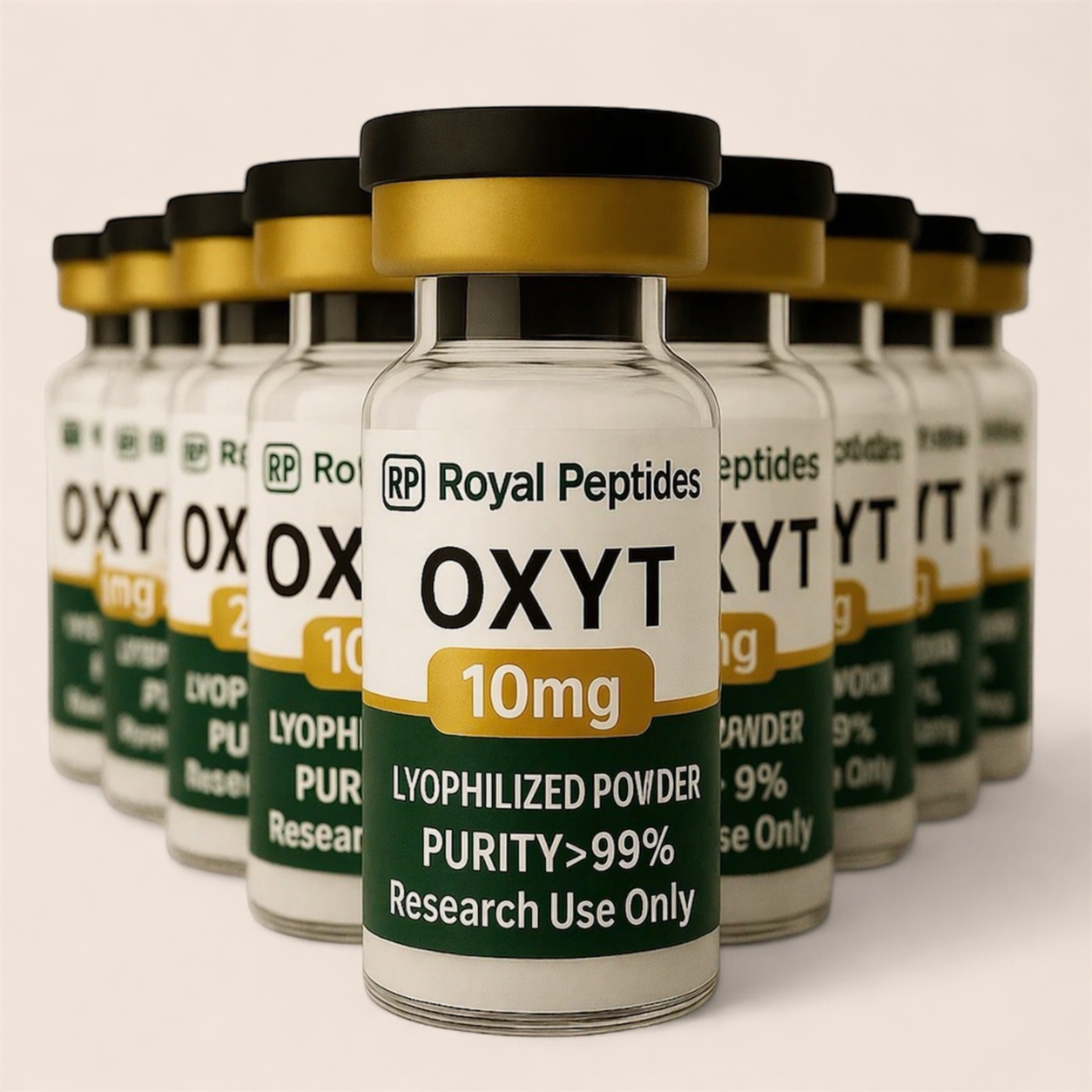
 Oxytocin 10mg
 Price range: $70 through $560Select options
Royal Peptides products are offered exclusively for laboratory research, analytical, and scientific applications. Not for human or veterinary use.
Royal Peptides supplies compounds intended for controlled laboratory research and analytical applications.
Where applicable, Royal Peptides research materials are supplied in lyophilized form.
Lyophilization is a freeze-drying process used to remove moisture from material under controlled conditions.
Storage requirements may vary by compound, formulation, and production lot. Refer to the product label and available product-specific documentation.
Packaging components may vary slightly between production lots. This can include vial closures, cap styles, label positioning, and external packaging.
Oxytocin 10mg is a research peptide supplied for laboratory investigation of oxytocin receptor signaling, neuroendocrine communication and peptide-mediated cellular pathways. Oxytocin is an endogenous cyclic nonapeptide composed of nine amino acid residues and is one of the most extensively characterized signaling peptides in mammalian physiology.
Oxytocin is an endogenous peptide hormone and neuropeptide synthesized as part of a larger precursor protein. The biologically active molecule is a compact nine-amino-acid cyclic peptide.
Oxytocin is particularly important to biochemical research because its effects are mediated primarily through the oxytocin receptor (OXTR), a member of the G-protein-coupled receptor family.
Activation of OXTR can initiate intracellular signaling cascades, making the oxytocin system a useful experimental model for studying receptor activation, calcium-associated signaling, neuroendocrine communication and peptide-receptor interactions.
Oxytocin and its receptor are studied across numerous areas of neuroscience, endocrinology, molecular biology and cellular signaling research.
Oxytocin is a cyclic nonapeptide. Its compact structure contains a disulfide bridge between two cysteine residues, producing the characteristic cyclic portion of the molecule.
The peptide's relatively small size and well-characterized receptor system have made oxytocin an important model compound for investigating how peptide structure influences receptor recognition and downstream cellular signaling.
Oxytocin consists of nine amino-acid residues with a disulfide-linked cyclic structure.
The oxytocin receptor provides a defined molecular target for peptide-receptor signaling experiments.
The oxytocin receptor is a G-protein-coupled receptor whose activation can influence intracellular signaling pathways, including pathways associated with phospholipase C and intracellular calcium.
Researchers use this system to examine how extracellular peptide signals are translated into intracellular responses.
Oxytocin occupies an unusual position at the intersection of neuroscience and endocrine biology. It is therefore frequently investigated as a model of neuroendocrine signaling.
Laboratory research has examined oxytocin-associated systems in relation to neuronal communication, receptor distribution, peptide release, feedback mechanisms and interactions between the nervous and endocrine systems.
These investigations help researchers characterize how peptide messengers can influence signaling across different tissues and biological systems.
Oxytocin provides researchers with a particularly useful model for studying peptide-receptor communication.
Its defined nine-amino-acid structure, characterized receptor and extensive scientific literature allow investigators to examine relationships between peptide structure, receptor binding and intracellular signaling.
Its role as an endogenous signaling molecule also makes the oxytocin/OXTR system relevant to broader investigation of neuroendocrine biology and intercellular communication.
Oxytocin is an endogenous cyclic nonapeptide that functions as a neuropeptide and peptide hormone and is widely investigated in neuroendocrine and receptor-signaling research.
Mature oxytocin consists of nine amino-acid residues, which is why it is classified as a nonapeptide.
Oxytocin primarily interacts with the oxytocin receptor, commonly abbreviated OXTR, which belongs to the G-protein-coupled receptor family.
Oxytocin is studied as a model for neuropeptide biology, neuroendocrine communication, receptor pharmacology and intracellular signaling.
This research product contains 10mg of Oxytocin per vial.
No. This product is supplied strictly for laboratory and research purposes and is not intended for human or veterinary use.
Product information pulled directly from WooCommerce.
Review available analytical documentation for the applicable product and batch.
View Analytical Documentation →Match available documentation to the applicable research material and batch.
Review the analytical information provided for the selected batch where available.
Keep relevant product and batch documentation with your research records.
Shipping options and delivery estimates are shown at checkout. Refer to the product label and applicable documentation for handling and storage information.
Complete payment using the available methods presented during checkout.
Tracking information is provided when available for the selected delivery service.
Use the product label and applicable documentation for handling and storage guidance.


 Oxytocin 10mgOxytocin 10mg
PREMIUM RESEARCH MATERIALS
You must be at least 21 years old to enter. All products are intended strictly for laboratory research only — not for human or veterinary use or consumption.
INDEPENDENT RESEARCH • QUALITY • TRANSPARENCY
Verification remembered for 30 days